Engaging Non-state Armed Groups: Lessons Learned – Introduction
16 min read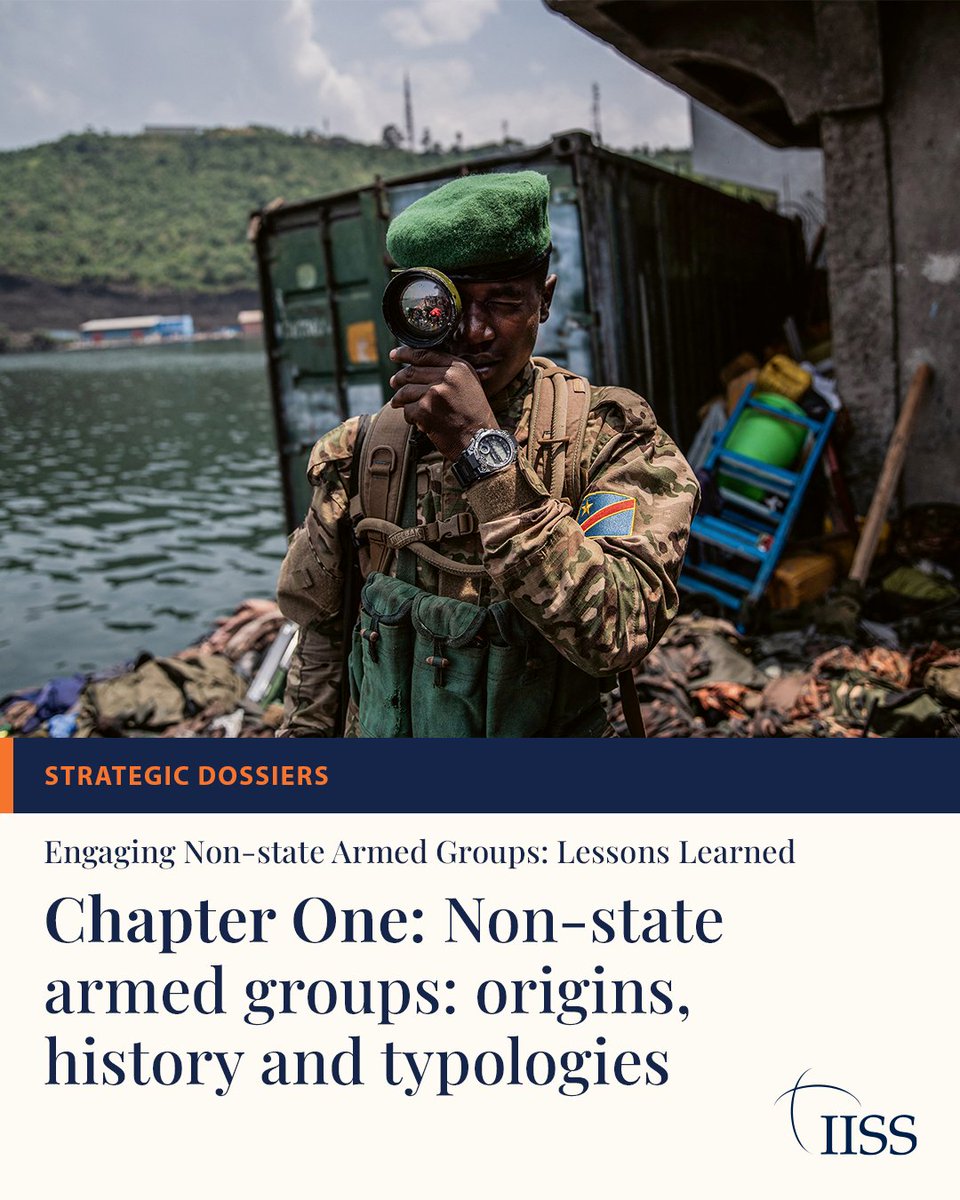
The IISS Strategic Dossier Engaging Non-state Armed Groups: Lessons Learned examines stabilisation tools that have been employed by international actors to engage with a range of non-state armed groups involved in violent conflicts.
Key features
- IISS experts trace the evolution of international actors’ engagement with non-state armed groups (NSAGs).
- After Chapter 1 introduces a typology of NSAGs, the dossier presents three thematic chapters providing a data-driven analysis of tools employed by international donors and organisations to engage NSAGs during and after war: Chapter 2 analyses the use of peace negotiation and mediation processes; Chapter 3 examines disarmament, demobilisation and reintegration (DDR); and Chapter 4 assesses security sector reform (SSR).
- Spotlights covering Haiti, Syria, the Horn of Africa and the Sahel explore specific attempts at implementing stabilisation tools, charting the successes and failures of international actors operating in demanding contexts.
———-******———-
The introduction of the IISS Strategic Dossier Engaging Non-state Armed Groups: Lessons Learned examines the rise of non-state armed groups involved in violent conflicts and sets out the stabilisation tools that have been employed by international actors to engage with them, including peace negotiation and mediation; disarmament, demobilisation and reintegration; and security sector reform.
In an era defined by increasing inter-state conflict and geopolitical rivalry, it may seem as if the threat posed by non-state actors is receding into the background of international affairs. Yet non-state armed groups (NSAGs) are becoming more, rather than less, important to global conflict and security dynamics. NSAGs are increasingly complex and diverse in character, with many internal conflicts now featuring multiple non-state actors as well as different types of NSAGs. Declining international cooperation is complicating efforts to engage with these groups and creating openings for non-state actors to entrench their power or expand their reach. Moreover, external sponsorship of NSAGs can have transnational repercussions, fuelling regionalised conflicts or driving international crises, as seen in the campaign by Israel and its allies to dismantle the Iran-linked ‘Axis of Resistance’.1
An instructive example of the impacts and ripple effects of NSAG activity can be found in the March 23 Movement (M23) in central Africa’s Great Lakes region. In early 2025, the M23 undertook a lightning offensive in the restive eastern provinces of the Democratic Republic of the Congo (DRC), following years of intermittent conflict between the insurgent group and the Congolese military and its allies. With direct support from the Rwanda Defence Force, the M23 was able to seize the capitals of the DRC’s North and South Kivu provinces, building on steady gains made since late 2021.2 The M23’s recent successes have been enabled by increased logistical and operational support from Rwanda, in addition to the failure of the Congolese government in Kinshasa to address long-standing deficiencies with the Congolese army.3 Since 2025, the M23 has established a parallel administration in the territory it controls, providing the Rwandan government in Kigali with additional means to project its power into its much larger neighbour.4
The conflict in the eastern DRC has rocked the Great Lakes region, triggering mass displacement and an underreported humanitarian crisis, while raising tensions between Rwanda and Burundi.5 Multiple state and non-state actors have orbited the conflagration, further militarising the region. Military and paramilitary forces from Burundi have supported the Congolese army, as have most parts of the fractious anti-M23 ‘Wazalendo’ militia coalition as well as the notorious Democratic Forces for the Liberation of Rwanda (FDLR).6 Meanwhile, a prominent Burundian opposition group – the Resistance for the Rule of Law in Burundi (known locally as RED Tabara) – is allegedly aligned with Rwanda, while Twirwaneho self-defence militias from South Kivu are allied with the M23.7 These actors fall across the Great Lake’s ethnic and geopolitical fault lines, and illustrate the close linkages between state and non-state forces, as well as the complex network of alliances and enmities that exist among the region’s various NSAGs.
Attempts at resolving the crisis have resulted in two separate peace tracks (one mediated by the United States, the other by Qatar), neither of which has made substantial progress towards bringing the war to an end. The future role of the M23 in the governance of the eastern DRC is a particular point of uncertainty and contention between the various parties to the conflict.8 The M23 itself emerged from previous rounds of peace negotiations and donor initiatives, in which authorities in Kinshasa reached for short-term solutions that would contain the problems in the distant east of the country. This included a series of flawed peace agreements that only minimally addressed the internal drivers of the violence and left the conflict’s regional dynamics largely untouched. Formal efforts at disarming the M23’s predecessor – the National Congress for the Defence of the People (CNDP) – resulted in the group hiding heavy weapons in anticipation of further conflict, while military integration of the CNDP intensified grievances within the Congolese army and the CNDP itself. After several years in which both sides sought to exploit the military integration process for tactical and financial ends, parts of the CNDP defected from the military in 2012 following contested elections the previous year, forming the M23 with the assistance of Kigali.9 The M23 was pushed out of the DRC in 2013 after a sustained offensive by Congolese forces and United Nations peacekeepers and remained dormant until relations between Kinshasa and Kigali deteriorated towards the end of 2021.
The rise and rise of non-state armed groups
In addition to underscoring the continued centrality of NSAGs in contemporary conflict and insecurity patterns, the case of the M23 also speaks to the decisive role that external support can play for NSAGs and the ability of non-state actors to withstand long periods of dormancy until geopolitical conditions become favourable for their re-emergence. It also raises questions about the long-term effectiveness of tools that have been used to engage with and regulate NSAGs. The eastern DRC has been an epicentre of both NSAG activity and international initiatives to engage with these groups, a number of which were directed at (and sometimes against) the M23 and its predecessor, the CNDP.10 Rather than leading to a transition from recurrent conflict to peace and development, these tools have instead provided footholds for NSAGs and military commanders to exploit a temporary peace and prepare for the next war.
Since the end of the Cold War, awareness in the international community about the importance of NSAGs has grown significantly. Encompassing a wide range of different entities in terms of size, organisational structure, political orientations and modes of operation – from guerilla fighters and organised crime groups to jihadist fighters such as al-Shabaab or the Islamic State – these groups are widely recognised as a threat to international peace and stability. Moreover, pro-government militias have been increasingly deployed by states engaged in internal conflicts to help offset the weaknesses or perceived disloyalty of formal security actors, creating complex and often hazardous security environments during and after war.11 Meanwhile, the global growth of NSAGs has also provided opportunities for certain states to augment their power on the international stage, as seen in the network of non-state and quasi-state actors cultivated by Iran across the Middle East, and increasingly in the United Arab Emirates’ alleged support for opposition groups and de facto states in northeast Africa.12 The wide variety of groups and contexts imposes challenges upon practitioners and policymakers seeking to engage with NSAGs.
While estimates for the numbers of active NSAGs vary considerably depending on how researchers and datasets define or measure them, an International Committee of the Red Cross (ICRC) survey identified over 380 armed groups of humanitarian concern globally in 2025, out of which over 130 are classified as NSAGs.13 The latter accounted for 36% of all tracked groups in 2025, the highest proportion in the survey’s history.
Importantly, many of these groups control substantial territory and function as de facto governing authorities within those areas. According to the ICRC, an estimated 204 million people were living under the full or contested control of armed groups in 2025. Of the groups monitored, approximately 85% were reported to provide public services, enforce security and/or levy taxes on the populations under their authority. Although most of the armed groups identified were concentrated in Sub-Saharan Africa (158) and the Middle East (85), the phenomenon was by no means regionally confined. Similar actors were also documented in the Americas (72) and in Asia and the Pacific (58), underscoring the global reach of the trend.
NSAGs remain central actors in contemporary violent conflict and insecurity. They continue to engage in hostilities against both state authorities and other NSAGs, competing for political power, territorial control, influence over populations and access to economic resources. Given the prominent role of NSAGs in global conflict dynamics, it is essential for analysts and policymakers to understand how the international community and state actors – including from governments and international organisations such as the UN or the European Union – can interact and engage with NSAGs. Besides engagement for humanitarian purposes, these interactions can take multiple forms. They may involve military and law-enforcement responses, as seen in the context of the global war on terror following the attacks of 11 September 2001. They can also include diplomatic and peacebuilding efforts, as have occurred in countries such as the Philippines, or at a more localised level in parts of the Sahel. In some cases, coercive and diplomatic approaches occur sequentially. For example, in Afghanistan, a two-decade-long NATO-led military intervention against the Taliban was followed by a negotiated withdrawal of Western forces in August 2021, while in Colombia, intensive counter-insurgency efforts forced the Revolutionary Armed Forces of Colombia (FARC) to the negotiating table in 2012. In other contexts, NSAGs may seize power through military means – such as in Syria – or through a negotiated power-sharing settlement, as occurred in Sudan’s 2005 Comprehensive Peace Agreement, which paved the way for the partition of the country in 2011. Across many of these examples, NSAGs have been engaged using tools designed to demobilise and disarm ex-combatants, or to encourage their participation in civilian politics rather than armed struggle. In a number of cases, they have also been incorporated into the statutory forces of the state.
Structure of the dossier
This dossier analyses the different policy interventions and tools that are frequently used by the international community to engage NSAGs along the war-to-peace continuum.14 To do so, it is necessary to unpack what is meant by the term and reflect on the various types of actors which are now classified as NSAGs.
Accordingly, Chapter 1 examines the historical development of NSAGs as well as the growing complexity of contemporary conflict landscapes. The latter is characterised by a proliferation of different types of NSAGs, ranging from criminal and violent extremist groups to armed groups that effectively function as de facto authorities over the territory they control. Contemporary NSAGs have diversified the strategies they use to advance their objectives at local, national and transnational levels, including through the use of violence and the development of governance capabilities. Although states have frequently sought to delegitimise NSAGs, non-state actors have increasingly sought to emulate states, and in many regions NSAGs have implemented their own governance projects, with the institution-building strategies of Syria’s Hayat Tahrir al-Sham in Idlib being a prominent example. In other cases, NSAGs have worked alongside governments, including external ones. The chapter puts forward a loose typology of these groups. However, NSAGs are growing increasingly complex and oftentimes do not fit neatly into a single category, instead spanning across several.
Chapter 2 examines the use of peace negotiation and mediation processes when engaging NSAGs. It outlines the core concepts, including the specificities of third-party mediation, and situates negotiation and mediation processes within broader peace processes. The chapter also examines the incentive structures that shape NSAGs’ decisions to enter negotiations or mediation processes, alongside the implications that stem from the proscription of certain types of NSAGs by Western states and international organisations (notably jihadist groups). The section also highlights the use of targeted sanctions – such as travel bans, asset freezes and arms embargoes – as a potentially complementary tool in different phases of peace processes. Moreover, the chapter emphasises the role of power politics in negotiation and mediation processes, and the tendency for these processes to be used as a means to reallocate post-war power, sometimes in ways that suit the interests of external mediators. While negotiation and mediation processes ended civil wars across the globe during the 1990s and early 2000s – including through comprehensive settlements in El Salvador (1992), Northern Ireland (1998) and Liberia (2003) – these tools are now struggling to produce the same results. A variety of factors, including the spread and fragmentation of conflict parties and widening geopolitical rifts (which have led to a proliferation of mediation efforts and mediators) have contributed to a shift from comprehensive peace settlements to partial and short-term deals, which are becoming increasingly transactional in nature.
Chapter 3 analyses the role of disarmament, demobilisation and reintegration (DDR) programmes in engaging with NSAGs. The concept of modern DDR emerged with the first UN-supported DDR programme in 1989 as part of the United Nations Observer Group in Central America.15 The chapter charts the transformation from first-generation DDR programmes which focused heavily on military aspects – and were implemented with NSAGs in various contexts, including parts of southern and western Africa – to second-generation programming, which incorporated more socio-economic elements, and contemporary, third-generation programming. While DDR was long seen as primarily a technical process, it took a series of failures for the international community to understand that DDR is, first and foremost, a political exercise, in particular for NSAGs who would need to transform from a military group to a civilian political party.16 Overall, the chapter shows that the evolution of DDR has involved an expansion of activities and objectives, in response to both lessons learned from previous DDR engagements and developments in the armed conflict landscape. Contemporary DDR programmes are increasingly implemented in ongoing conflict contexts marked by volatility and security conditions that are not conducive to meeting programme objectives. At the same time, the proliferation of some sub-types of NSAGs – including criminal groups and violent extremist groups – complicates traditional approaches to DDR, which were premised on the assumption that the prospect of political normalisation and societal reintegration will incentivise most NSAGs to disarm and demobilise.
Finally, Chapter 4 examines the use of security sector reform (SSR) in war-to-peace transitions. Similarly to DDR, SSR is a highly political process that has implications for post-war power allocation. The chapter outlines how the SSR concept was formalised in the late 1990s and encompasses efforts to restructure a country’s military, paramilitary and police force (and can extend to reforming the judicial, penal and intelligence sectors) with the aim of producing effective and accountable institutions while reinforcing civilian oversight of security actors. NSAGs may be engaged during SSR through integration into the state’s formal security institutions, particularly into the armed forces, in a process that can increase the risks of conflict or infighting, as has occurred in South Sudan. The chapter observes how the state-centric logic underpinning SSR approaches has caused difficulties in contexts that are characterised by weaker state institutions and stronger non-state actors. In such cases, hybrid and fragmented security sectors have emerged, in which the line between state and non-state actors is eroded. The chapter concludes by situating SSR within changes to the international order and the decline of multilateralism. These transformations are creating opening points for emerging powers to engage in SSR or SSR-like activities, usually on a bilateral basis with recipient countries.
Key themes and implications
The relationship between NSAGs, conflict and conflict resolution is fluid rather than static. NSAGs’ military tactics develop in response to (and sometimes drive) changes in how conflicts are fought, while the political and economic strategies of more organised NSAGs adapt to shifts, realignments or openings in the international order. A similar interplay exists between NSAGs and international powers seeking to engage with or dismantle non-state actors. While the individual chapters in the dossier highlight specific findings and themes, there are several cross-cutting themes that emerge from these chapters and indicate possible trajectories for how established and emerging powers might engage with NSAGs in the coming decades.
Firstly, many of the tools that are featured in the dossier have been guided by an implicit (and sometimes explicit) desire on the part of international donors to reinforce the power of recipient state institutions. This is often achieved by either incorporating NSAGs into state or military structures, or else by disbanding these actors so that they do not pose a serious security threat to the state, usually through reintegrating into civilian life or transitioning into a formal political party. This approach has been relatively effective in some instances, but has been less effective – or even counterproductive – in contexts where there is societal and political opposition to centralised state rule (e.g., Somalia),17 or where attempts to create formal security sectors are met with suspicion or resistance, including from within the state itself (e.g., Libya).18 The structure of these societies renders them prone to entrenched NSAG activity, and the architecture of the security sector tends to be highly fragmented, which can feed into further NSAG proliferation during periods of political turbulence or regime change.
Moreover, establishing durable institutions is exceptionally challenging in transactional political systems. This is particularly so when ruling regimes are accustomed to outsourcing governance or security functions to NSAGs or powerful strongmen, or have depended upon international actors for resources, security or legitimacy, as has been the case in the DRC and Afghanistan.19 In such contexts, the weak or contested nature of the state means that local identities (including ethno-linguistic, cultural or religious identities) are often more potent than national ones, and international efforts to consolidate state power at the national level can have unanticipated repercussions for the local level. This interplay between international, national and local actors can lead to complex or protracted security crises in provincial areas, while tools that were intended to curb insecurity caused by non-state actors can instead empower them. The current tools for engaging with NSAGs are also less effective in contexts where national elites have a vested interest in maintaining their presence, and where the sponsorship of NSAGs by local, national or regional actors is an established practice.
Secondly, international approaches to addressing conflict have become less coherent, and have struggled to effectively adapt to the growing complexity, variety and number of NSAGs globally. Since the mid-to-late 2000s, the tools used to tackle NSAGs – including DDR and SSR – have gradually drifted from an initial narrow focus on civil–military relations, post-conflict security and the management of security forces to a broader set of activities. These expanded activities include socio-economic programmes to consolidate peace, the strengthening of judicial institutions and the rule of law, and the bolstering of the coercive capabilities of post-conflict and conflict-affected states to help control the flow of weaponry and suppress active security threats.20 This ‘mission creep’ has particularly impacted DDR and SSR programming, resulting in inconsistent outcomes while increasing the logistical complexity and financial cost of these programmes.
Conversely, peace agreements have become fewer in number and less comprehensive in scope, and now focus more on halting national or localised conflicts instead of addressing the structural causes of violence or its societal impacts.21 Additionally, several major ongoing conflicts – including the war in Sudan – are exposed to external meddling and competition between third parties. This complicates peace negotiations by requiring mediators to resolve rivalries or conflicts between the external sponsors of a war, in addition to its domestic belligerents. These challenges are compounded by the waning appetite among Western donors to fund expensive peace interventions in remote and strategically peripheral countries, and a reluctance to invest in the difficult task of addressing the underlying grievances or dysfunctional and factionalised political systems that tend to sustain NSAG networks.
Finally, although quantitative data on the numbers of DDR and SSR programmes that have been (or are being) implemented is limited, it is evident that there are fewer high-profile DDR or SSR missions taking place in the 2020s compared to the first two decades of the century. While several SSR and DDR interventions have taken place since 2020, the number of programmes appears to be lower than in recent decades.22 International engagement appears to be largely confined to three programmes that began life in the second half of the 2010s, in the Central African Republic (CAR) and Mali (both of which have hosted SSR and DDR projects with UN and World Bank support), and to a lesser extent Nigeria (which has a set of DDR programmes for ex-jihadist combatants, for which some international assistance is provided).23 However, information on most recent or active programmes is scarce, making it hard to ascertain whether they are comparable to previous SSR or DDR programmes in terms of the breadth or depth of the activities being pursued or implemented, and in a number of cases it is not possible to determine how national and international actors are dividing tasks between themselves.24 Meanwhile, the UN has begun to move away from DDR programming and towards more modest ‘community violence reduction’ initiatives.25 These combine elements of the reintegration phase of DDR with more traditional peacebuilding tools, and seek to limit the risk of community recruitment by NSAGs in addition to the re-recruitment of ex-combatants.
When taken in conjunction with the relative decline in the number and scope of peace agreements, these trends might suggest that some of the tools for engaging with NSAGs that have been developed and deployed in the post-Cold War era are beginning to fall into disuse, or are perhaps even fading into irrelevance. However, it is important to remember that these tools themselves had antecedents: programmes for disarming and demobilising soldiers and ex-combatants existed long before the first DDR programme emerged in 1989, as did forms of (often bilateral) engagement with militaries and other security actors by international powers prior to the label of ‘security sector reform’ being introduced in 1998. Similarly, international peace mediation was already an established practice by the end of the Cold War, even if international mediators had been more concerned with settling or defusing inter-state rather than intra-state conflicts.26
Whether these tools will survive in their current form is unclear. There is less doubt, however, that these tools will endure in some form, even if this form differs in important respects from existing practices, blends elements of current tools with new ones, or evolves in response to NSAG adaptation in ways that we currently cannot foresee. It is equally likely that the types of states that engage with NSAGs, their motivations and the geopolitical circumstances in which they do so will change. The tools discussed in this dossier crystallised during a period when a relatively small club of Western states were able to shape the global security order, and reflected the initial optimism and sense of possibility of the post-Cold War era. The preoccupation of Western powers with external security threats (particularly jihadist groups and ‘failed states’) after 11 September 2001 and economic decline in the wake of the 2008 financial crisis has influenced the subsequent trajectory of these tools, resulting in a more explicit focus on building durable states in the Global South to limit the spread of NSAGs, followed by hesitancy to commit to ambitious and costly interventions amid setbacks in Afghanistan and Iraq and rounds of fiscal austerity.
Although most Western states are likely to remain engaged with NSAGs, they will be joined in this endeavour by non-Western states, including emerging powers. Understanding which tools for engaging NSAGs have achieved their desired outcomes – and under what circumstances – and which ones have not will therefore be of importance both to existing donors and practitioners who may be seeking to re-evaluate their engagements or partner with new players, and to relative newcomers seeking to avoid past mistakes and chart a new course that reflects their own political or security objectives.
Download the Strategic Dossier
By IISS News | @IISS_org